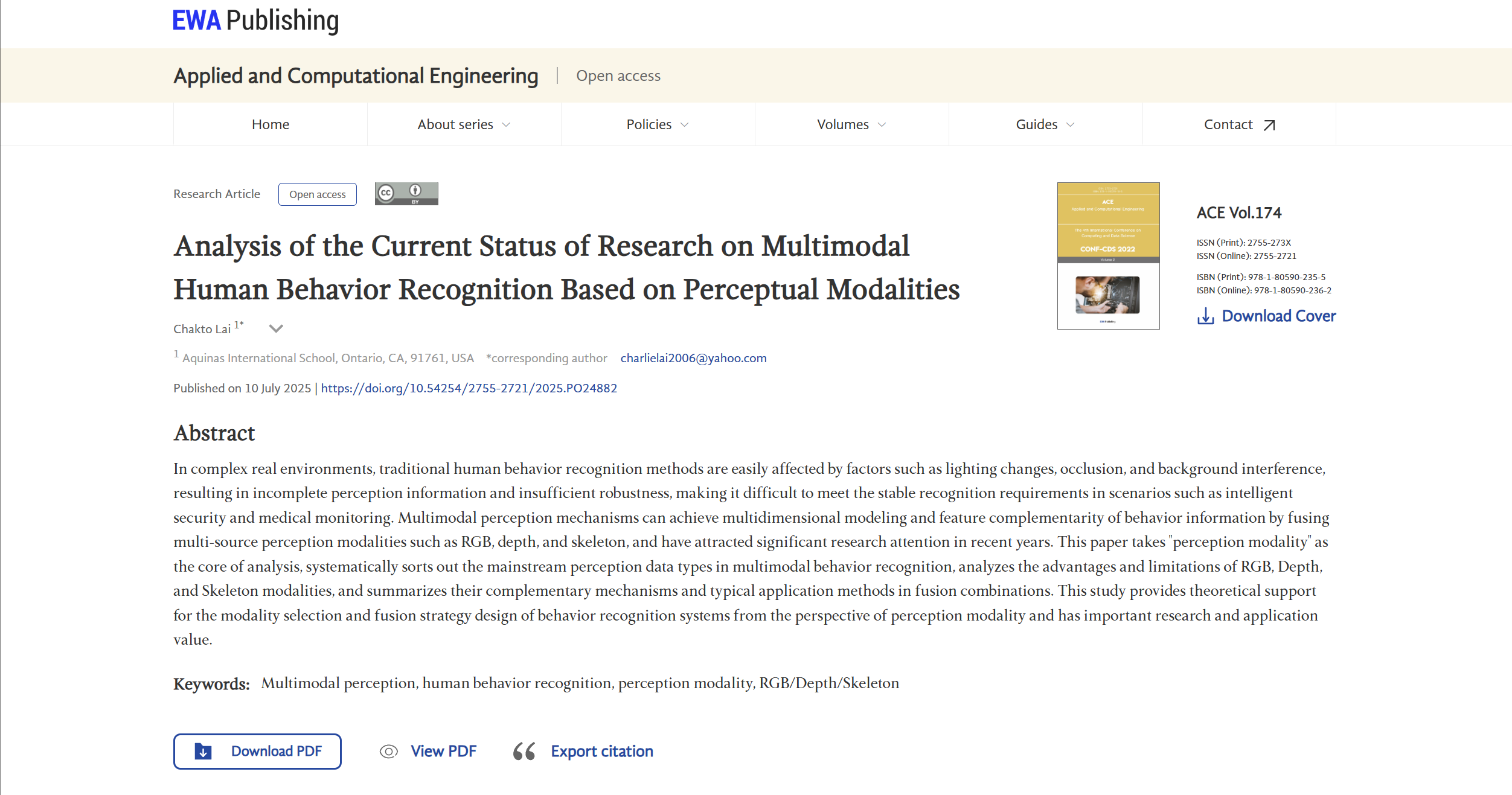

— A Personal Milestone in High School
📄 Paper Title: Analysis of the Current Status of Research on Multimodal Human Behavior Recognition Based on Perceptual Modalities
📚 Published in: Applied and Computational Engineering, EWA Publishing
🗓️ Timeline: Started writing in mid-March 2025 → Submitted on June 9 → Officially published on July 10
🔗 Link to paper: Read the full paper here
🌱 Where It All Started: Curiosity + Ambition
It began in mid-March 2025 when I joined a research course on “AI and Games.” The teacher allowed us to choose our own topic, and something about the term “perceptual modality” immediately caught my attention.
I’ve always been fascinated by AI, image processing, and how machines “understand” human behavior. I wasn’t sure if I could write a full academic paper as a high school junior, but I decided to try.
Sure, I hoped this would be a nice addition to my future college application — but deep down, I really just wanted to understand how human actions are recognized by machines.
🎮 From Games to Human Behavior Recognition
At first, I wanted to write about the use of perceptual modalities in game AI. But as I began reading papers, I quickly realized that many of the methods were too complex for me at the moment — involving advanced models like transformers and temporal modeling.
So, I changed direction.
Instead of chasing the “cutting edge,” I went back to the fundamentals. I chose to write a review paper focusing on the three core modalities used in human behavior recognition:
- 📷 RGB images — rich in visual information, but sensitive to lighting and occlusion
- 📏 Depth maps — good for 3D structure, but lack semantic detail
- 🕴️ Skeleton data — efficient and robust, but sparse
This perspective was often overlooked in many high-level surveys, which made it a perfect entry point for someone like me.
📝 Writing Process: From Chaos to Clarity
I reviewed 10 core research papers and gradually organized my thoughts into a clear outline:
- Introduction to perceptual modalities
- Comparative analysis of RGB, Depth, and Skeleton
- Benefits and methods of multimodal fusion
- Challenges and future directions in the field
The hardest part wasn’t writing itself — it was figuring out how to structure everything and which sources to trust. But once the framework clicked, the rest flowed naturally. That was the first time I realized academic writing is more about clarity and logic than using “big words.”
📄 Publication Day: A Quiet Victory
After weeks of effort, I submitted the paper to Applied and Computational Engineering under EWA Publishing. When I saw my name listed as an author on the official site, it wasn’t loud excitement that I felt — it was quiet, steady pride.
Yes, I’m still in high school. But I had written, submitted, and published a formal academic paper.
That’s something I’ll always remember.
🧠 What I Really Learned
Sure, I learned a lot about perceptual modalities. But what I gained most was:
- ✅ The ability to build a solid research structure
- ✅ The habit of reading critically and thinking independently
- ✅ The confidence to say, “I can do this, even as a high school student.”
It taught me that research isn’t just for professionals. With the right mindset, even high school students can contribute meaningful insights to a field.
💬 A Letter to Myself
Dear future me,
This is where it all began. You spent four months crafting your first paper — reading, outlining, writing, revising, doubting, and finishing. You didn’t take shortcuts. You didn’t give up.
This paper is more than just a publication. It’s your first real step into research. It’s proof that you are curious, patient, and willing to do the hard work.
So wherever you go, please remember:
You started all this in 11th grade, simply because you loved it.
That’s enough reason to keep going.
📎 Link to the original paper: https://www.ewadirect.com/proceedings/ace/article/view/24882